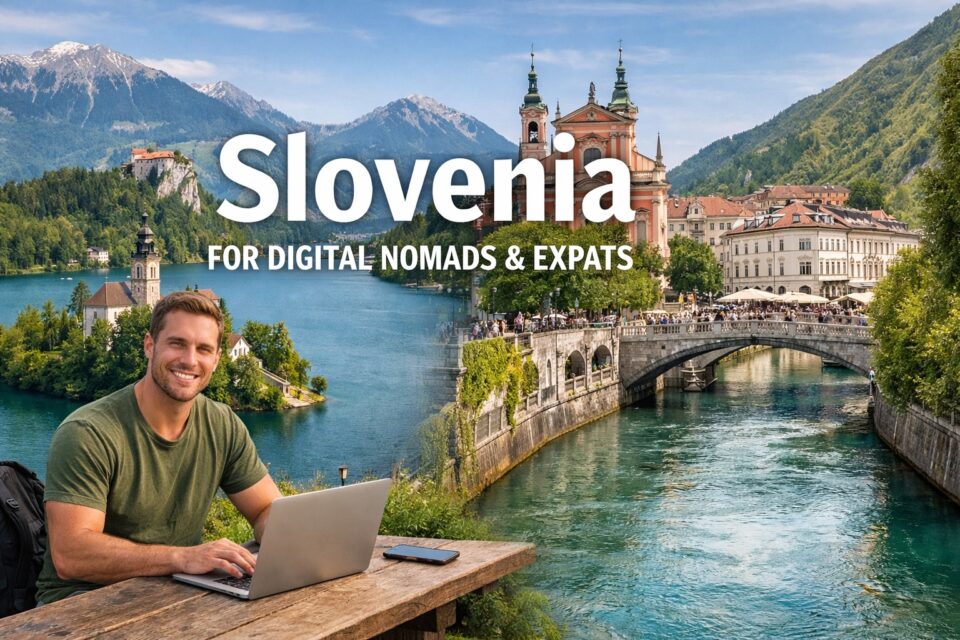
Why Slovenia is popping up on nomad radar
Across nomad communities, the recurring “why” behind new destination hype tends to be the same: legal clarity, reliable connectivity, safety + quality-of-life, and community infrastructure. Those are explicitly named pain points and decision drivers in recent nomad discussion trend summaries.
For broader context: nomads frequently cite visa limitations (including the 90-day Schengen rule), Wi-Fi reliability, coworking, and community-building as the practical make-or-break factors, with crypto increasingly showing up as a tool in the lifestyle. This guide is about Slovenia for digital nomads and expats.
Slovenia now ticks an unusually clean set of boxes for an EU country: compact, outdoorsy, well-connected, and (crucially) a defined nomad permit pathway.
Visa and stay options (Nomads + Expats)
1) If you’re EU/EEA/Swiss
You generally rely on EU free movement. The “visa problem” is mostly administrative (registration, health coverage, tax residency planning).
2) If you’re non-EU and want a short stay
Slovenia is in Schengen, so the standard rule applies: up to 90 days in any 180-day period across the Schengen area.
3) Slovenia’s Digital Nomad permit (the key update)
Slovenia introduced a temporary residence permit for digital nomads starting 21 Nov 2025.
Who it’s for (official definition):
- Non-EU/EEA nationals who work remotely for:
- an employer/company based outside Slovenia, or
- as a self-employed person abroad,
and the point is you do not enter the Slovenian labour market.
Duration & renewability
- Issued for up to one year
- Cannot be extended
- You may reapply 6 months after the previous permit expires.
Where to apply
- At a Slovenian diplomatic or consular post abroad
- Or, if you’re already legally in Slovenia, at an administrative unit.
Income requirement
- You need monthly funds of at least twice the average monthly net salary in Slovenia (calculated based on the most recently published average gross salary in the Official Gazette).
- Slovenia’s tourism portal summarises this as “twice the average net salary… currently about €1,600” (expect this to move with wage stats).
Family
- More favourable family reunification: family members can reunite immediately (no waiting tied to duration of residence/permit validity).
Document checklist (practical)
Expect to prove:
- identity + clean record (criminal record certificate)
- remote work relationship (contracts / employer letter / client agreements)
- income that meets the threshold
- valid international health insurance
Important nuance
This permit is designed around remote income from outside Slovenia (i.e., not taking local-market work).
Taxes: what changes in Slovenia for digital nomads and expats
Two separate issues matter:
- Tax residency: if you spend long enough in Slovenia (or establish “centre of vital interests”), you can become a tax resident. This is highly personal (country ties, treaty position, income type). Treat it as planning, not vibes.
- Crypto transparency is tightening across the EU. Slovenia’s Financial Administration highlights the rollout of DAC8 / CARF reporting (automatic exchange of crypto-asset information), including a timeline starting 2026 for provider obligations and 2027 reporting for 2026 data.
Crypto in Slovenia: practical reality (not just “crypto-friendly” vibes)
Day-to-day usage (Ljubljana)
Ljubljana has a unique “real-world crypto” footprint through BTC City’s “Bitcoin City” initiative and its history of piloting retail crypto payments and integrations.
That doesn’t mean you can pay everywhere in crypto, but it’s a genuine signal that:
- merchants have tested solutions,
- there’s local know-how,
- and there’s a visible blockchain and startup ecosystem in the capital.
Tax treatment: what to watch
Historically, Slovenia’s tax authority guidance has indicated that capital gains from the disposal of virtual currencies are generally not subject to personal income tax when trading is outside a business activity (details depend on facts).
But a proposed shift has been in discussion.
- Business/industry commentary on the draft ZDDOKS points to a proposed flat 25% tax on disposals without holding-period differentiation.
- Big-picture takeaway: don’t assume yesterday’s “tax-free” narrative will hold; plan for change and keep records (timestamps, cost basis, transfers). Read more about crypto taxes.
Where to live in Slovenia (best bases by lifestyle)
Slovenia is small enough that “where you live” is mostly about your preferred daily texture: city rhythm, coast, or mountains – with nature always close.
Ljubljana: best all-around base
Pick Ljubljana if you want:
- the strongest mix of cafés, culture, events, and international vibe
- easiest access to admin/logistics
- the deepest coworking/community options (e.g., Impact Hub Ljubljana, Work From Slovenia community).
Maribor: second city, calmer, often better value
Good for:
- a slower pace
- access to wine country and outdoors
- fewer crowds than the capital.
Coastal Slovenia (Koper / Izola / Piran area): sea + Italy feel
Best for:
- people who work better near water
- warmer shoulder seasons
- weekend hopping to Trieste/Venice-style vibes (without living in Italy prices).
Outdoors-first bases (Bled / Bohinj / Soča Valley proximity)
These are for:
- hiking, trail-running, lakes, Alps energy
- “I work early, disappear into nature after” schedules.
(Do expect seasonal crowding and fewer work-focused venues outside main tourist hubs.)
Lifestyle reality check (advantages + drawbacks)
What Slovenia does exceptionally well
- “Compact Europe” advantage: EU + Schengen + euro makes life operationally simple and travel friction low.
- Cost position (for an EU country): price levels for household-consumed goods/services around 90% of EU-27 average (not “cheap”, but not Western-capital expensive either).
- Health coverage footprint: Slovenia’s tourism portal emphasises that healthcare is widely spread, with health centres in cities and emergency coverage nationwide.
- Nomad pathway exists now: the 12-month permit removes a major “EU-but-no-visa” blocker for non-EU nomads.
Common drawbacks you should mention (so the article feels honest)
- The nomad permit is non-renewable (you need a 6-month gap to reapply), which complicates “I’ll just stay indefinitely” plans.
- Housing pressure in peak seasons in the most popular spots (Ljubljana, Bled, the coast) – expect higher prices and less availability.
- Weather seasonality: winters can feel long if you’re used to Mediterranean climates.
- Language barrier outside Ljubljana: totally doable, but expect more English in the capital than in smaller towns.
A practical “Slovenia setup” checklist for nomads
- Choose your base (Ljubljana for first-time logistics).
- If non-EU and staying longer: confirm you qualify and prepare the digital nomad permit docs (remote work proof, income, insurance, record).
- Keep clean financial records (especially crypto): exchanges, wallets, transfers, cost basis – DAC8/CARF reporting is coming online across providers.
- Plug into community early (it’s the difference between “lonely EU stop” and “I could live here”).
Conclusion: who Slovenia is best for
Slovenia for digital nomads is a strong match if you want:
- EU legality + Schengen mobility,
- a balanced lifestyle (city + nature),
- a country that’s not drowning in nomad hype yet,
- and a place where crypto is usable enough to matter, without being the entire identity of the destination.


