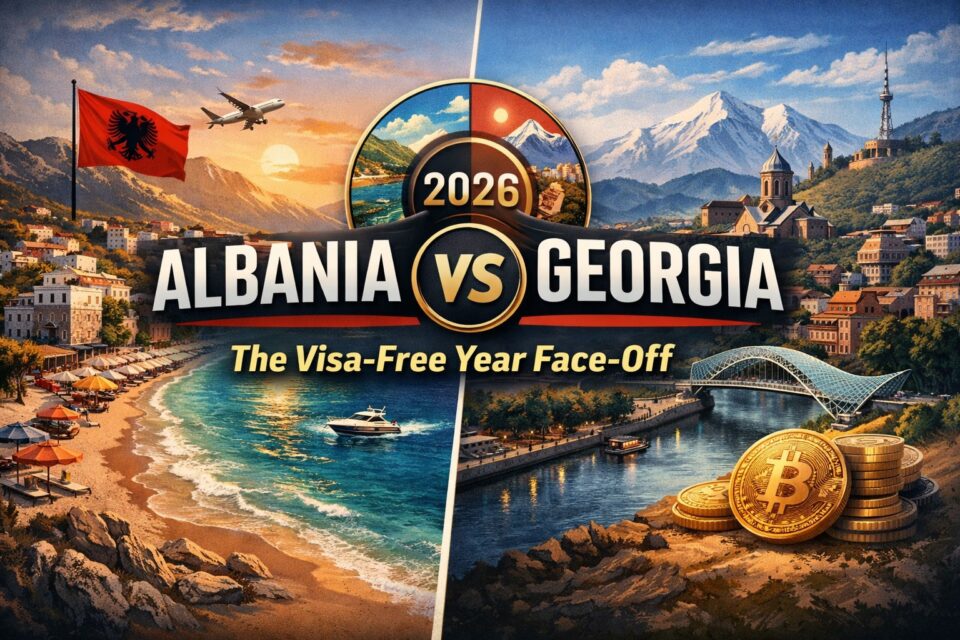
Why nomads keep choosing these two countries
If you’re a holder of a fairly strong passport and you want the “easy button” in Europe-adjacent territory, Albania and Georgia show up for the same reasons:
- Long, simple stays (the famous “I can just live here for a year” factor)
- Affordable day-to-day compared to much of Western/Central Europe
- Coastline + city bases (beach mode isn’t a once-a-year thing)
- Lifestyle density: cafés, walkable neighbourhoods, solid food culture, enough infrastructure to run a business.
On paper, they’re twins. In real life, they’re two different lifestyles with different friction points. This review is to compare Albania vs Georgia, so you can make your own choice.
The core difference of Albania vs Georgia in one line
Albania feels like “Mediterranean Europe on easy mode.”
Georgia feels like “a serious base country with mountains attached.”
That difference shows up everywhere: time zone fit, how you travel, what your weekends look like, how social your daily life feels, and even how naturally crypto fits into your routine.
Visa & entry: what “one year” actually means in practice
Albania for Americans
The U.S. State Department notes that U.S. citizens don’t need a tourist visa, and if you intend to stay more than one year, you’ll need to apply for a residency permit. It also lists passport validity of at least three months from arrival.
The U.S. Embassy in Albania also states U.S. citizens may stay up to one year without a residence permit.
Practical translation: Albania is extremely “live first, formalise later” friendly for Americans, up to a year.
Georgia for Americans
The U.S. State Department states U.S. citizens may enter, reside, work or study in Georgia without a visa for up to 365 days, but border authorities can still ask questions and deny entry at their discretion.
Practical translation: It’s easy, but don’t treat it as automatic – arrive looking like a normal traveller with normal answers.
New in Georgia: mandatory travel insurance (2026)
Starting January 1, 2026, tourists entering Georgia must provide proof of valid health and accident insurance.
Some published guidance also describes requirements such as coverage for the full stay and availability in Georgian or English, plus a stated minimum coverage figure of 30000 GEL.
Practical translation: Put “travel insurance PDF” in your arrival checklist for Georgia in 2026. Your airline will require you to have it.
Where you’ll actually live: best bases (and who they fit)
Albania: best bases
Tirana
Your best year-round hub: community density, services, admin, gyms, cafés, coworking, airport access. If you want a “base with trips,” Tirana is the logical anchor.
Durres / Golem
Coast access without giving up city practicality (especially if you want beach runs and a calmer vibe).
Vlore
A strong “work + sea” option, especially if you want the coast to be your default.
Saranda + the Albanian Riviera
Peak summer lifestyle. Gorgeous, but seasonal and can get pricier in high season.
Who Albania fits best: people who want coast-first living and Europe proximity without the EU price tag.
Georgia: best bases
Tbilisi
The main nomad/expat engine. If you like cafés, social routines, meetups, and a real capital-city vibe, Tbilisi is the place.
Batumi
Black Sea boulevard, summer energy, and “I live by the water” mood – more seasonal, but very livable if you like resort-city vibes.
Kutaisi
Often underrated: cheaper, calmer, strong access to western nature routes.
Who Georgia fits best: people who want a serious base, city energy, and weekend adventures that aren’t just “another beach.”
Lifestyle comparison: what your weeks will feel like
Albania feels like…
- Mediterranean rhythm: later nights in summer, sea culture, coastal weekends
- EU-hopping practicality: you’re in the Balkan “lane” for short flights and weekend breaks
- Familiarity: Latin alphabet reduces friction (signs, menus, admin)
Best for: “I want to work hard, then live outside.”
Georgia feels like…
- A real base country: you can build routines (gyms, favourite cafés, friend groups) fast
- Nature density: mountains, hikes, escapes that feel dramatic
- Distinct identity: different script and language, very strong food/wine culture
Best for: “I want to build a life structure, not just a season.”
Costs & affordability: “cheap” shows up differently in Albania vs Georgia
I’m not going to throw fake-precise monthly numbers at you (nomad budgets vary wildly), but here’s the honest pattern most Americans experience:
Albania’s cost curve
- Tirana is usually reasonable and predictable
- Riviera towns can spike in summer (short-term rentals, restaurants, beach clubs)
- You can keep Albania very affordable, but the coast can tempt you into “holiday spending”
Georgia’s cost curve
- Tbilisi tends to offer strong daily value: food, transport, and services; rents in the central parts could be higher.
- Batumi can behave like a seasonal city (summer is pricier, winter is much calmer).
- If you’re cost-sensitive and want a full city base, Georgia often feels like the better value.
Rule of thumb:
- If your priority is Mediterranean summer life, Albania can be worth the seasonal premium.
- If your priority is value + routine + base-building, Georgia often wins.
Remote work reality: internet, coworking, and time zones
Internet & workspace
In both countries, major cities generally handle Zoom and remote work well. The difference is less about pure connectivity and more about how your working day feels.
Time zone fit (this matters more than people admit)
- Albania (CET/CEST) is a natural match if your work touches Europe.
- Georgia (GET) runs ahead of Europe and far ahead of the Americas, so it’s great if you want early-morning deep work and you’re not chained to US hours daily.
If you’re working with US clients every day, Georgia can mean late calls. If you’re building content, doing async marketing, or running your own business, Georgia’s time zone can actually be a productivity weapon.
Safety & comfort: the official posture (and what it means)
The U.S. State Department travel advisory pages currently list:
- Albania: Level 2 – Exercise Increased Caution (notably due to crime).
- Georgia: Level 1 – Exercise Normal Precautions, with Level 4 (Do Not Travel) guidance for Abkhazia and South Ossetia.
How to interpret this like a nomad:
- Albania: be more deliberate with petty-theft prevention and late-night awareness.
- Georgia: generally comfortable in main areas, but treat the “occupied regions” warning as non-negotiable.
Money & payments: what’s easiest day-to-day
Most Americans in both countries run a hybrid setup:
- Card-first where possible
- Cash backup for small places/taxis
- A second card from a different bank/network (because travel happens); consider also obtaining a crypto card for increased peace of mind.
Albania: more “European normal” in payment feel, especially in Tirana and tourist zones.
Georgia: very workable card culture in cities, and also a strong “everything is a quick app or a quick cashier” vibe.
Now let’s talk about the part most nomads ignore until they get burned: financial resilience.
Crypto notes for nomads: what actually matters in Albania vs Georgia
I’m not doing “crypto speculation travel vibes.” I’m talking about crypto as a backup rail for real life: rent, emergencies, border moves, and “my bank suddenly hates me today.”
Georgia: clearer VASP oversight + a more visible crypto scene
The National Bank of Georgia (NBG) maintains a framework around Virtual Asset Service Providers (VASPs) and provides information about registration and the VASP register.
NBG also announced amendments that take effect January 1, 2026 and notes it identifies entities providing virtual asset services without registration and warns consumers against using unregistered entities.
Practical takeaway in Georgia:
- If you use local crypto services, treat registration status as a safety filter.
- Expect a more “mature compliance posture” than the wild-west vibe some nomads chase.
Albania: an early DLT market law + crypto framework evolving
Albania has an English-language law on financial markets based on Distributed Ledger Technology (Law No. 66/2020), which defines concepts like tokens and DLT platforms and sets a regulatory basis for DLT-based markets.
Practical takeaway in Albania:
- Albania has a formal legal basis for DLT markets, but your day-to-day crypto experience will still often look like: use global tools, keep records, and plan your off-ramp intentionally.
The “Nomad Money Stack” for either country (do this before you arrive)
Here’s the setup that prevents 90% of travel-money panic:
- Primary spending card (your normal bank)
- Backup card (different bank, ideally different network)
- Stablecoin buffer (USDC/USDT) in a non-custodial wallet
- Off-ramp option (trusted exchange account + withdrawal method; crypto card usually helps)
- Emergency cash (enough for 3–7 days).
If you want the full system, link this section to: “Nomad Money Stack 2026: The 4-Layer Setup That Survives Locked Accounts.” (internal link placeholder)
And don’t forget to check:
- “Best Crypto Wallets for Nomads” (comparison page)
- “What Makes a Crypto Wallet Secure” (security guide)
- “Best Crypto Cards for Travel” (cards comparison)
- Stablecoins guide (understand stablecoins)
- Scams guide (avoid scams while travelling).
Who should choose Albania vs Georgia (decision guide with real use cases)
Choose Albania if you’re…
1) The EU-hopper
You want weekend breaks and an easy European rhythm. Albania’s geography and time zone help you live a “Europe-connected” life without EU costs.
2) The coast-first nomad
Your mental health improves when the sea is nearby. Albania’s Riviera summer lifestyle can feel like a cheat code.
3) The low-friction starter
You want less “culture decoding” at first and more “I can just live.”
Example Albania profile:
A US freelancer working mostly with European clients, wants beach workouts, a social summer, and quick flights for city breaks.
Choose Georgia if you’re…
1) The base-builder
You want to build a routine: gym + café circuit + community + projects. Tbilisi excels at “I can live here” energy.
2) The value maximiser
You want your daily life to feel rich without spending like a tourist.
3) The crypto-forward nomad
You care about resilient rails and a more visible crypto ecosystem, and you prefer using providers with clear oversight signals.
Example Georgia profile:
A content creator / marketer running an async business, wants mountains on weekends, loves food and wine culture, and keeps a stablecoin buffer for freedom. And similarly, if you feel you’d like Black Sea, consider Batumi as your spot, here is my crypto in Batumi review.
The split-year strategy (the move seasoned nomads make)
If you can, stop thinking “either/or” and think “seasonal optimisation”:
- Albania: May → September
Coast lifestyle, peak social energy, Mediterranean pace - Georgia: October → April
Tbilisi base season, strong routines, nature trips, better value months
This is how you get the best of both worlds without forcing one country to be something it isn’t.
First-week playbook (so your arrival isn’t chaos)
Albania: your first 7 days
- Day 1–2: set up a practical neighbourhood in Tirana (walkability + café density)
- Day 3: coworking test day + SIM setup + gym scout
- Day 4–5: 1–2 coastal day trips (Durres/Vlore) to feel the coastline reality
- Day 6–7: lock a longer-term rental after you’ve lived the routine once
Georgia: your first 7 days
- Day 1–2: pick a Tbilisi neighbourhood and do a “routine walk” (café → grocery → gym)
- Day 3: coworking test day + SIM setup
- Day 4: run your money stack test (card works, backup works, stablecoin wallet works)
- Day 5–7: one “escape weekend” (even a short one) to validate why Georgia is special.
And don’t forget the 2026 requirement: have insurance proof ready for Georgia entry.
Recommendations on Most Popular Products:
Trezor | Ledger | Tangem | Bitbox | Safepal | Keystone
ByBit Card | WhiteBit Earn Program
FAQ on Albania vs Georgia
Can US citizens stay a full year in Albania without a visa?
Official guidance indicates U.S. citizens don’t need a tourist visa and can stay up to a year; staying beyond that generally requires a residency permit.
Can US citizens stay 365 days in Georgia without a visa?
Yes, official guidance states U.S. citizens may enter, reside, work or study without a visa for up to 365 days.
Do I need travel insurance for Georgia in 2026?
Yes, Georgia requires proof of valid health and accident insurance for tourists starting Jan 1, 2026.
Is Albania or Georgia “safer”?
The U.S. travel advisory posture currently lists Albania at Level 2 and Georgia at Level 1, with specific “do not travel” regions in Georgia.
Which is better for crypto users?
Georgia has a more visible oversight framework via the National Bank of Georgia’s VASP registration context; Albania has a formal DLT-market legal basis (Law No. 66/2020).
Final verdict on Albania vs Georgia
If you want Mediterranean summer + Europe at your doorstep, Albania is the better match.
If you want a serious base, strong routines, mountains, and a more crypto-visible environment, Georgia is the better match.
And if you want maximum freedom per dollar, do both – Albania for peak summer, Georgia for everything else.
Before you choose a country for “freedom,” make sure your money setup matches the mission:
My recommended setup if you’re getting paid in crypto (what I actually use almost daily)
Receive: Bybit crypto exchange
Hold spending money: WhiteBit (Earn program with fixed plans offering the best APR)
Spend: WhiteBit crypto card (best cashback on subscriptions like Spotify – 10%)
Long-term storage: Trezor hardware wallet
Tax records: Koinly tax software


